
Options for Birth When Your Baby Appears to be Big on a Scan

“Big” also known as: growing larger than expected, large for gestational age (LGA), above the 90th centile, more than 4kg at term (37-42 weeks)

This decision aid has been developed by a multidisciplinary working group comprising two women representing Patient and Public Involvement and Engagement (PPIE), Consultant Midwives, Consultant Obstetricians, academics and researchers. It is designed to support women’s decision-making by providing evidence-based information and to enhance clinician-led counselling through the use of a structured, woman-centred framework.

Contents

Scans late on in pregnancy are not very accurate at predicting birth weight. In a recent study, only 4 out of 10 babies predicted to be big were actually big at birth.

You have been given an estimated weight; however, the following information is based on ACTUAL birth weight.

Why Does Having a Big Baby Matter?

Women have an increased chance of having an emergency caesarean birth during labour, a perineal tear involving the anus, and/or a significant bleed after the birth of a big baby.

Out of 100 women... If baby weighs...
Less than 4kg More than 4kg More than 4.5kg
Caesarean in labour* 30 /100 35 /100 45 /100
Tear involving the anus 1 /100 2 /100 3 /100
Post-birth bleed 2 /100 5 /100 6 /100

* This will be lower if you have previously had a vaginal birth

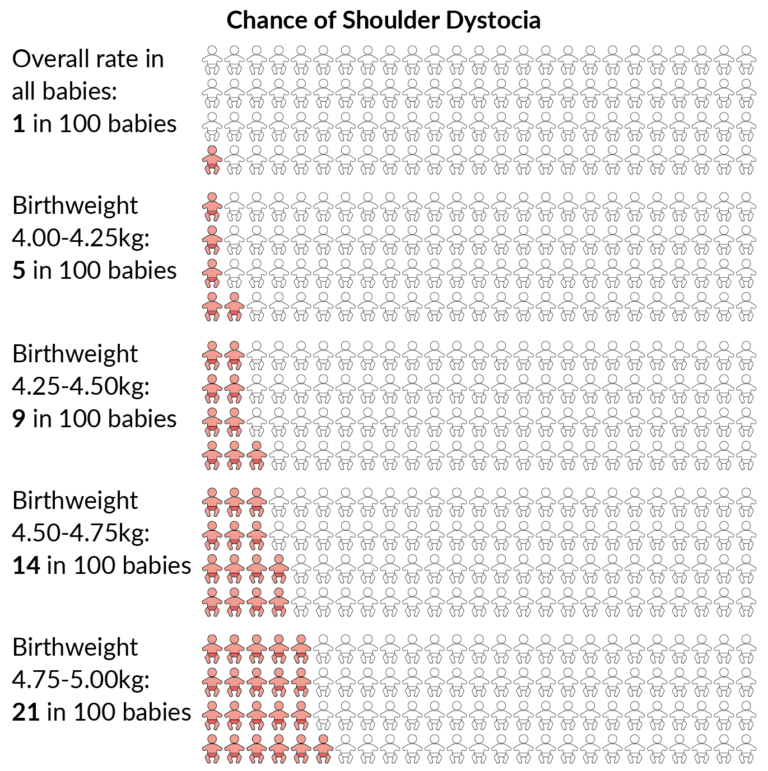
Babies who weigh more than 4kg at birth have an increased chance of shoulder dystocia (difficulty birthing the shoulders – see FAQ below for more details).

In 9 out of 10 babies, the shoulders are released with simple manoeuvres without causing any permanent injury.

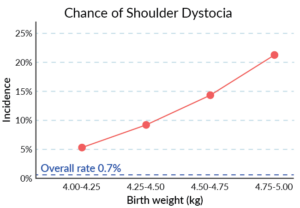
Infographic showing various chances of shoulder dystocia based on birthweight. Overall rate in all babies is 1 in 100 babies. Rate in babies with a birthweight between 4-4.25 kg is 5 in 100 babies. Rate in babies with a birthweight between 4.25-4.5 kg is 9 in 100 babies. Rate in babies with a birthweight between 4.5-4.75 kg is 14 in 100 babies. Rate in babies with a birthweight between 4.75-5 kg is 21 in 100 babies.

Options to Consider for Birth

Previous births

Clinical assessment

Maternal expectations & preferences

Benefits:
  • Labour might start by itself.
  • 9 out of 10 babies who have shoulder dystocia will be born promptly and safely with simple manoeuvres.
  • No difference in chance of tear involving the anus.
Risks:
  • The longer you wait, the larger the baby will grow.
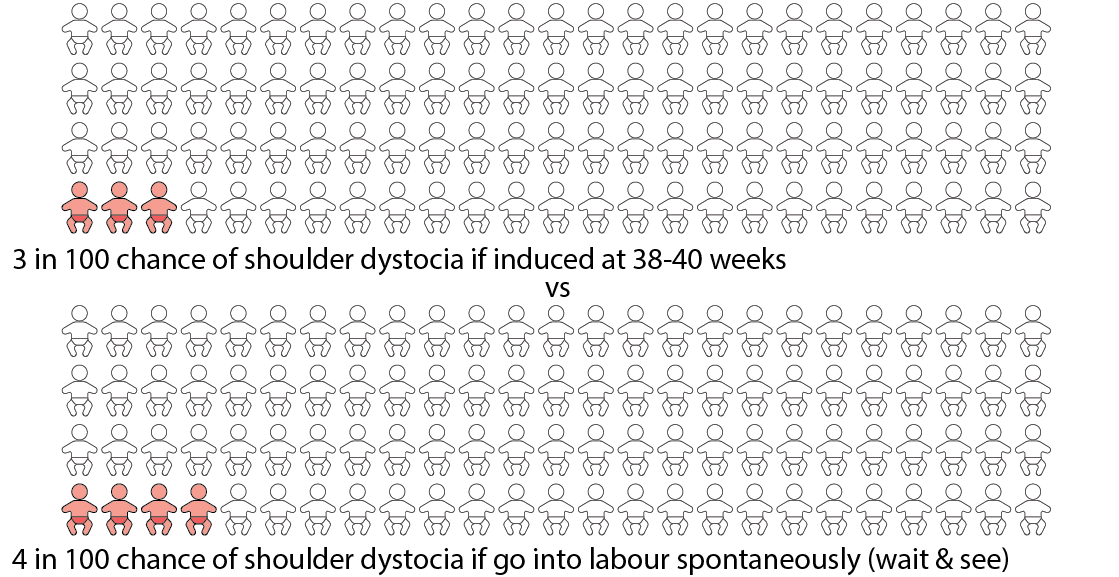
  • Increases chance of shoulder dystocia: 4 in 100 vs 3 in 100 babies.
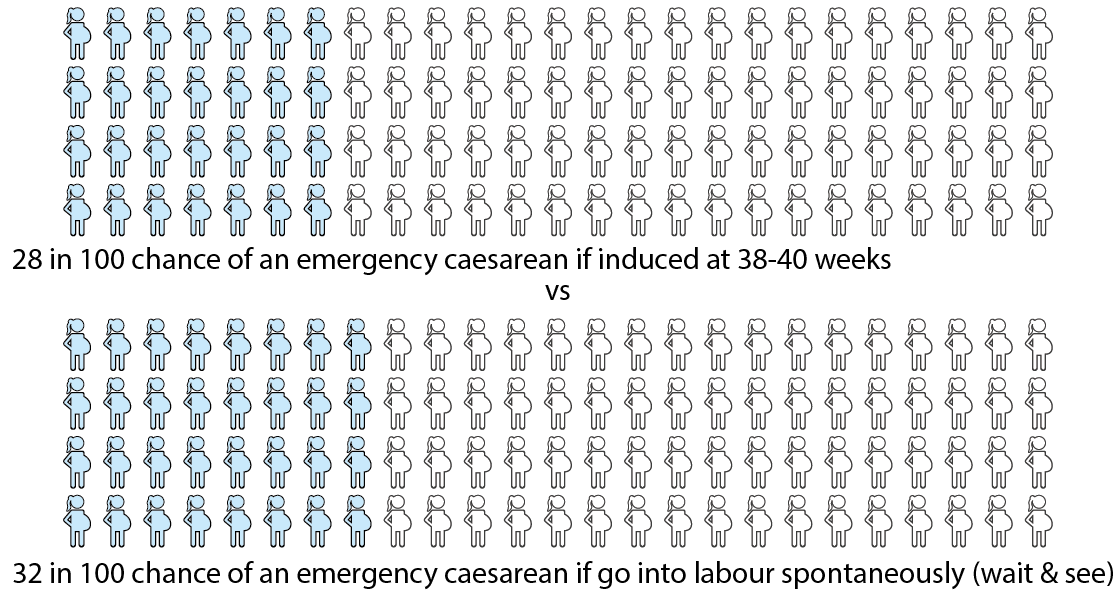
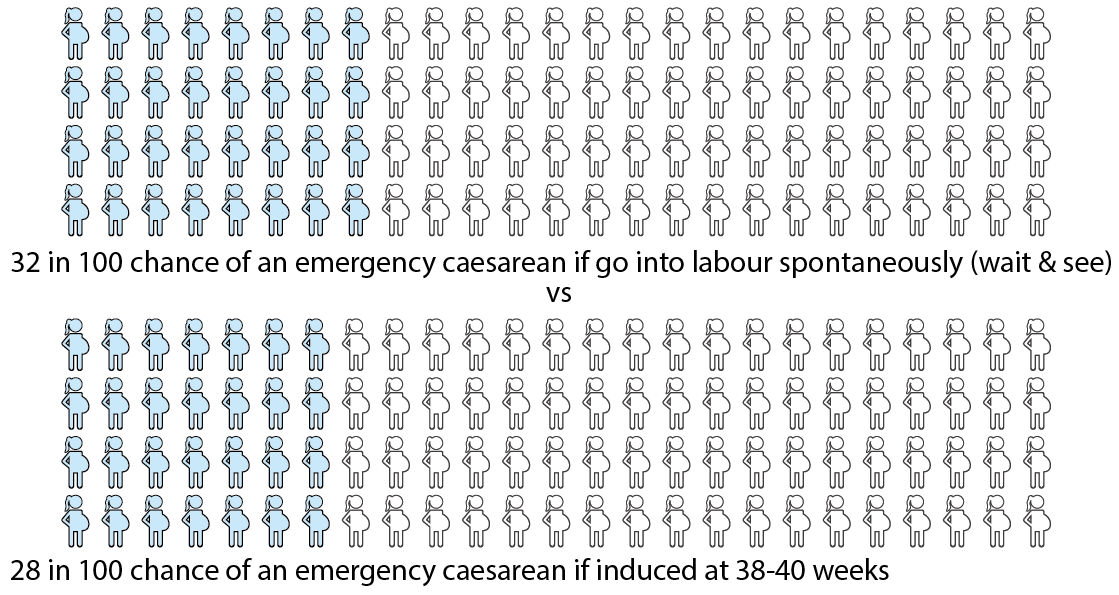
  • Increases chance of having an emergency caesarean: 32 in 100 vs 28 in 100 women.
Alternatives:
  • Membrane Sweeps can be given to help soften the cervix, which may help labour to start.
Benefits:
  • Reduces chance of shoulder dystocia because the baby will be smaller: 3 in 100 vs 4 in 100 babies.
  • Reduces chance of having an emergency caesarean: 28 in 100 vs 32 in 100 women.
  • No difference in chance of assisted birth with forceps or ventouse.
Risks:
  • Increased need for phototherapy in newborn babies to treat jaundice.
  • Longer hospital stay.
Benefits:
  • Prevents shoulder dystocia.
  • Minimises chance of having an emergency caesarean birth in labour.
  • Around 1 in 10 women go into labour before their scheduled date. If this occurs, you will be given the option to have an emergency caesarean or continue with a vaginal birth.
Risks:
  • Increases chance of significant bleed after birth.
  • Increases chance of infection.
  • Longer recovery and increased pain after birth.
  • Impacts subsequent pregnancies / births.
Alternatives:
  • If labour starts by itself before the date of your planned caesarean, you could choose to aim for a vaginal birth.

Other Things You Might Want to Think About or Discuss with Your Doctor / Midwife

Considering your history / health / previous births:
What do you feel is right for you?

Are there any further questions you want to ask?
For example, will this impact my preferred place of birth? Can I still have a water birth?

What is important to you?

Frequently Asked Questions

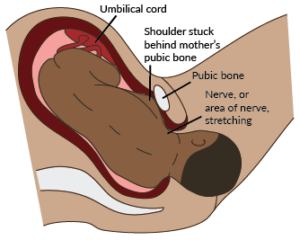
Cartoon drawing of a cross-section of a baby being born but their shoulder is stuck behind the mother's pubic bone cause stretching to the nerve

Shoulder dystocia – or difficulty giving birth to the shoulders of the baby – is when the baby’s head has been born, but one of the shoulders becomes stuck behind the mother’s pubic bone. If shoulder dystocia does happen, extra help is needed to release the baby’s shoulder.

Chart showing the chance of shoulder dystocia increases as birth weight increases - an incidence rate of ~5% for birth weight 4-4.25kg, an incidence rate of ~10% for 4.25-4.5kg, an incidence rate of ~15% for 4.5-4.75kg, and an incidence rate of ~21% for 4.75-5kg. In comparison the overall rate is 0.7%

  • 9 out of 10 babies who have shoulder dystocia will be born promptly and safely with no permanent damage.
  • About 1 in 10 babies who have shoulder dystocia will have some stretching of the nerves in the neck, called brachial plexus injury (BPI), which may cause loss of movement to the arm. The most common type of BPI is called Erb’s palsy. In 9 out of 10 babies who sustain a BPI this damage is temporary, and movement will return within hours or days.
  • Permanent nerve damage is rare (1 in 10,000 babies), however there is some evidence that suggests it is ten times more likely in babies who weigh more than 4.5kg (1 in 1,000 babies).
  • Sometimes shoulder dystocia can cause other injuries, including fractures of the baby’s arm or shoulder. In the majority of cases, these heal extremely well.
  • Very rarely a baby can suffer brain damage or death if they do not get enough oxygen due to the birth being delayed by the shoulders.

A significant bleed after birth is called a postpartum haemorrhage (PPH). PPH can be minor (500–1000 ml) or major (more than 1000 ml). The blood loss can come from perineal trauma and/or an atonic womb (a womb that does not stay contracted following placental separation).

A PPH can sometimes be life threatening, but more often women can feel faint, dizzy and weak and need a longer stay in hospital to recover. Some women may need a blood transfusion.

A perineal tear that is deeper and extends to the muscle that controls the anus (the anal sphincter) is called a third- or fourth-degree tears, also known as an obstetric anal sphincter injury (OASI).

Diagram showing third and fourth degree perineal tears

To repair a third- or fourth-degree tear, you will be transferred to an operating theatre as soon as possible after your baby is born. You will need an epidural or a spinal anaesthetic (rarely a general anaesthetic may be necessary) so that you have good pain relief whilst your muscles are repaired. You will have stitches between your vagina and anus (see diagram) and also underneath your skin. The stitches will eventually all dissolve (soften and fall out).

Around 6–8 in 10 women with a third- or fourth-degree tear will have no long-lasting complications after it has been repaired and given time to heal. A small number of women will experience anal incontinence – difficulty in controlling their bowels or holding in wind. There is specialist treatment available for this in the form of physiotherapy or surgery.

Additional Resources

Patient Information:
Guidelines:
  • National Institute for Health and Care Excellence. Inducing labour. NG207. 2021.
Patient Information:
Guidelines:
  • National Institute for Health and Care Excellence. Caesarean birth. NG192. 2025.
Patient Information:

Please note, these links are to external sites – we are not responsible for the content or operation of any linked site.

Profiles

Mairead Black

Mairead Black is a Reader and honorary consultant obstetrician in Aberdeen. She has a research interest in supporting informed birth choices. She leads the NIHR-funded Plan-A project developing a mode of birth decision aid for use in routine NHS antenatal care.

Sadia Haqnawaz

Sadia Haqnawaz is a member of ‘The Hilda’s’ patient and public involvement and engagement (PPIE) group at the University of Birmingham and Birmingham Biomedical Research Centre’s Women’s Metabolic Health Theme. 

Samantha Russell

Samantha Russell is a a patient and public contributor with extensive experience in research and policy development. Her work focuses on supporting high‑quality, patient‑centred research and healthcare improvement, with particular attention to Equality, Diversity and Inclusion.

She also supports teams with study design, service development and implementation activities to help ensure the needs of diverse communities are represented and reflected in improvement work.

William Parry-Smith

Prof. Parry-Smith is based at Shrewsbury & Telford Hospital NHS Trust and has expertise in maternity safety, obstetric haemorrhage and delivery of complex clinical trials. He supports national initiatives,  to enhance patient safety, risk stratification, and quality of care in obstetrics. 

Fran Carroll

Dr Fran Carroll is a health services researcher with over ten years’ experience working in the areas of maternity service evaluation and women’s health. 

She is currently Head of Research Partnerships at the Royal College of Obstetricians and Gynaecologists.

Abi Merriel

Abi Merriel is an academic obstetrician focused on optimising decision making for women and supporting staff in enabling this decision making Birth Options. As an NIHR Advanced fellow She is developing and testing communication tools and a prediction model to support women in their decision-making around birth.

Richard Lilford CBE

Prof. Richard Lilford is a professor at the University of Birmingham, with a medical background in obstetrics and gynaecology. He is Co-Director of the NIHR Midlands PSRC.

Richard has extensive experience in Patient Safety research, having led the successful UK Department of Health’s Patient Safety Research Programme (PSRP)  from 2001-2010.

Annie Lester

Annie Lester is a consultant midwife at University Hospitals Birmingham and research fellow at University of Birmingham, working with the NIHR Midlands PSRC.

Annie has a special interest in supporting informed decision making and provision of personalised care.

Louise Tucker

Louise Tucker is a consultant midwife at Royal Bolton Hospital.

Louise has a special interest in optimising birth outcomes and experiences through informed decision making.

Peter Chilton

Peter Chilton is a research fellow at the University of Birmingham, working alongside the NIHR Midlands PSRC. He designed the layout of the decision aid and the website, along with the illustrations and infographics.

Skip to content